
Moisture Contamination in Cryogenic Nitrogen Plants: Causes, Symptoms, and Prevention
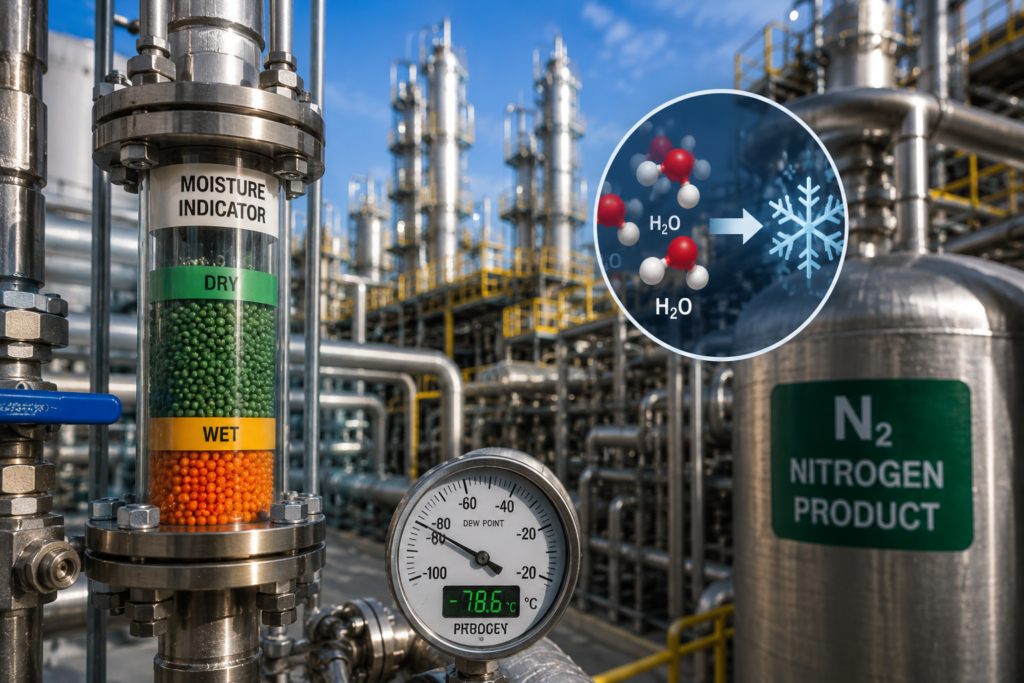
Moisture Contamination in Cryogenic Nitrogen Plants is one of the most serious operational threats encountered in air separation and nitrogen generation facilities. While moisture appears harmless at ambient conditions, it becomes a major concern as process temperatures approach cryogenic levels.
In cases of Moisture Contamination in Cryogenic Nitrogen Plants, water vapor entering the cold section freezes immediately and gradually accumulates inside process equipment. This ice formation can restrict flow passages, increase pressure drop, reduce heat transfer efficiency, disturb refrigeration balance, and destabilize plant operation.
Many problems that appear as purity fluctuations, production losses, pressure instability, or increasing power consumption can ultimately be traced to Moisture Contamination in Cryogenic Nitrogen Plants. Understanding how moisture enters the system and recognizing early warning signs are essential for maintaining reliable and efficient plant operation.
Why Moisture Is Dangerous in Cryogenic Systems
At cryogenic temperatures, water freezes immediately.
Unlike liquid water in conventional systems, frozen moisture can:
- Restrict process passages
- Increase pressure drop
- Reduce heat transfer
- Disturb refrigeration balance
- Cause process instability
- Reduce plant capacity
Because ice accumulates gradually, problems often develop slowly and become difficult to diagnose.
The operational consequences of Moisture Contamination in Cryogenic Nitrogen Plants often develop gradually, making diagnosis difficult until plant performance deteriorates significantly.
Common Sources of Moisture Contamination
Most cases of Moisture Contamination in Cryogenic Nitrogen Plants originate from inadequate air pretreatment or improper maintenance practices.
Molecular Sieve Breakthrough
The most common source of moisture contamination is inadequate air pretreatment.
Possible causes include:
- Incomplete regeneration
- Adsorbent degradation
- Valve leakage
- Incorrect switching sequence
- Channeling inside the adsorber
Moisture Ingress During Maintenance
Cold box openings, piping modifications, and maintenance activities can introduce moisture into the system.
Potential risks increase when:
- Equipment remains open for extended periods
- Dry air purging is inadequate
- Storage procedures are not followed
Instrument and Utility Connections
Leaks through utility systems, sampling systems, or instrument connections may allow moisture to enter process equipment.
Quick Engineering Summary
Moisture Contamination in Cryogenic Nitrogen Plants is one of the leading causes of pressure-drop increases, production losses, purity fluctuations, and process instability. Moisture entering the cryogenic section freezes immediately and gradually restricts process passages, reducing heat transfer and disturbing refrigeration balance.
Effective prevention depends on excellent air pretreatment performance, continuous trend monitoring, early investigation of abnormalities, and disciplined operating practices.
Common Symptoms
Symptom 1: Increasing Heat Exchanger Pressure Drop
What Operators Observe
- Rising pressure drop
- Higher compressor discharge pressure
- Increased power consumption
Likely Cause
Ice formation gradually restricts exchanger passages.
Increasing pressure drop is frequently one of the earliest indicators of Moisture Contamination in Cryogenic Nitrogen Plants.
Symptom 2: Reduced Nitrogen Production
What Operators Observe
- Production below design capacity
- Stable operating conditions but lower output
Likely Cause
Flow restrictions reduce effective plant throughput.
Production losses caused by Moisture Contamination in Cryogenic Nitrogen Plants usually develop gradually as ice accumulation increasingly restricts process flow.
Symptom 3: Nitrogen Purity Fluctuation
What Operators Observe
- Unstable purity readings
- Increased process adjustments
Likely Cause
Disturbed refrigeration balance and column instability caused by moisture-related restrictions.
Disturbed refrigeration balance caused by Moisture Contamination in Cryogenic Nitrogen Plants can significantly affect distillation efficiency and nitrogen purity.
Symptom 4: Process Instability
What Operators Observe
- Pressure oscillations
- Temperature fluctuations
- Frequent controller activity
Likely Cause
Flow disturbances caused by ice accumulation within the cold section.
Repeated operational fluctuations may indicate advanced Moisture Contamination in Cryogenic Nitrogen Plants and require immediate investigation.
Early Warning Signs
Operators should investigate immediately if they observe:
- Rising pressure drop
- Increasing power consumption
- Production decline
- Temperature profile deviations
- Repeated process instability
- Unexpected purity fluctuations
Early recognition of Moisture Contamination in Cryogenic Nitrogen Plants significantly reduces operational risk and prevents major production losses.
Troubleshooting Approach
Successful troubleshooting of Moisture Contamination in Cryogenic Nitrogen Plants requires identifying the contamination source rather than reacting only to visible symptoms.
Step 1: Review molecular sieve performance.
Verify:
- Regeneration temperatures
- Switching sequence
- Adsorber differential pressure
- Dew point trends
Step 2: Review historical operating data.
Compare:
- Pressure drop
- Production rate
- Purity trends
- Power consumption
Step 3: Evaluate heat exchanger performance.
Look for:
- Temperature approach changes
- Flow restrictions
- Refrigeration imbalance
Step 4: Identify moisture source.
Correcting symptoms without eliminating the contamination source often leads to recurring problems.
Prevention Best Practices
Preventing Moisture Contamination in Cryogenic Nitrogen Plants depends primarily on maintaining excellent molecular sieve performance and disciplined maintenance procedures.
Maintain Excellent Air Pretreatment
Regularly verify:
- Regeneration effectiveness
- Valve operation
- Adsorbent condition
- Dew point performance
Control Maintenance Activities
Use:
- Dry air purging
- Moisture exclusion procedures
- Controlled equipment opening practices
Monitor Key Trends
Trend:
- Pressure drop
- Temperature profile
- Production rate
- Purity
- Compressor power consumption
Common Mistakes
Many cases of severe Moisture Contamination in Cryogenic Nitrogen Plants result from delayed investigation of minor abnormalities that initially appear insignificant.
Ignoring Small Pressure-Drop Increases
Many moisture problems begin with small changes that appear insignificant.
Treating Symptoms Instead of Causes
Increasing compressor load or adjusting process settings does not eliminate moisture contamination.
Delayed Investigation
The longer moisture remains in the system, the greater the operational impact.
Practical Engineering Insight
Many operators treat increasing pressure drop, production losses, or purity fluctuations as independent process problems. However, in many plants, these symptoms are early indicators of Moisture Contamination in Cryogenic Nitrogen Plants.
Because ice accumulation occurs gradually, performance deterioration often develops slowly over weeks or months. Historical trend analysis frequently reveals early warning signs long before major operational disturbances become visible.
Engineering Perspective
From an engineering perspective, Moisture Contamination in Cryogenic Nitrogen Plants should be considered a plant-wide reliability issue rather than simply a molecular sieve problem. The consequences extend beyond the cold box and directly affect refrigeration efficiency, heat exchanger performance, distillation stability, production capacity, and energy consumption.
The most reliable nitrogen plants focus on contamination prevention rather than contamination removal. Investment in molecular sieve reliability, dew point monitoring, valve integrity, and disciplined maintenance practices consistently provides greater long-term benefits than reactive troubleshooting after moisture has entered the cryogenic section.
Related Engineering Insights
- Process Instability in Cryogenic Nitrogen Plants
- Cryogenic Heat Exchanger Icing in Nitrogen Plants
- Nitrogen Purity Fluctuation in Cryogenic Plants
- Cryogenic Heat Exchanger Troubleshooting Guide
- Maintenance of Cryogenic Heat Exchangers in Nitrogen Plants
- Cold Box Troubleshooting Guide
- Low Nitrogen Production in Cryogenic Nitrogen Plants
- Low Nitrogen Purity in Cryogenic Nitrogen Plants
- Distillation Column Instability in Cryogenic Nitrogen Plants
- Process Instability and Operational Fluctuation
Related Engineering Guides

Engineering Basis
- International Society of Automation – Control loop behavior, analyzer interaction, and process stability
- Process Control Engineering – System dynamics and feedback interactions
- National Institute of Standards and Technology – Gas property behavior under varying temperature and pressure
Conclusion & Key Takeaways
Moisture Contamination in Cryogenic Nitrogen Plants is often the hidden root cause behind many operational problems. Heat exchanger restrictions, low nitrogen production, purity fluctuations, increasing pressure drop, and process instability can all originate from inadequate moisture control within the cryogenic section.
Because the effects of Moisture Contamination in Cryogenic Nitrogen Plants usually develop gradually, early warning signs are often overlooked until plant performance deteriorates significantly. A proactive strategy focused on molecular sieve reliability, continuous trend analysis, moisture exclusion during maintenance, and disciplined operating practices remains the most effective approach for preventing contamination and maintaining reliable, efficient, and stable plant operation.
Key Takeaways
- Moisture Contamination in Cryogenic Nitrogen Plants is one of the most serious operational threats in cryogenic systems.
- Moisture freezes immediately at cryogenic temperatures and gradually restricts process passages.
- Increasing pressure drop is often the earliest warning sign.
- Production loss and purity fluctuations frequently originate from moisture-related restrictions.
- Molecular sieve breakthrough remains the most common contamination source.
- Historical trend analysis is essential for early detection.
- Effective prevention depends on excellent air pretreatment and disciplined maintenance practices.
- Early investigation significantly reduces operational risk and maintenance costs.
- Contamination prevention is more effective than contamination removal.
Protect Your Plant from Moisture-Related Failures
Moisture entering the cryogenic section can silently trigger a chain of operational problems, including rising pressure drop, reduced production, purity fluctuations, increased energy consumption, and process instability. By the time symptoms become obvious, performance degradation may already be significant.
Access practical engineering resources and troubleshooting guides designed to help you identify early warning signs, improve molecular sieve reliability, prevent moisture ingress, and maintain stable plant performance.