
Cryogenic Heat Exchanger Troubleshooting Guide
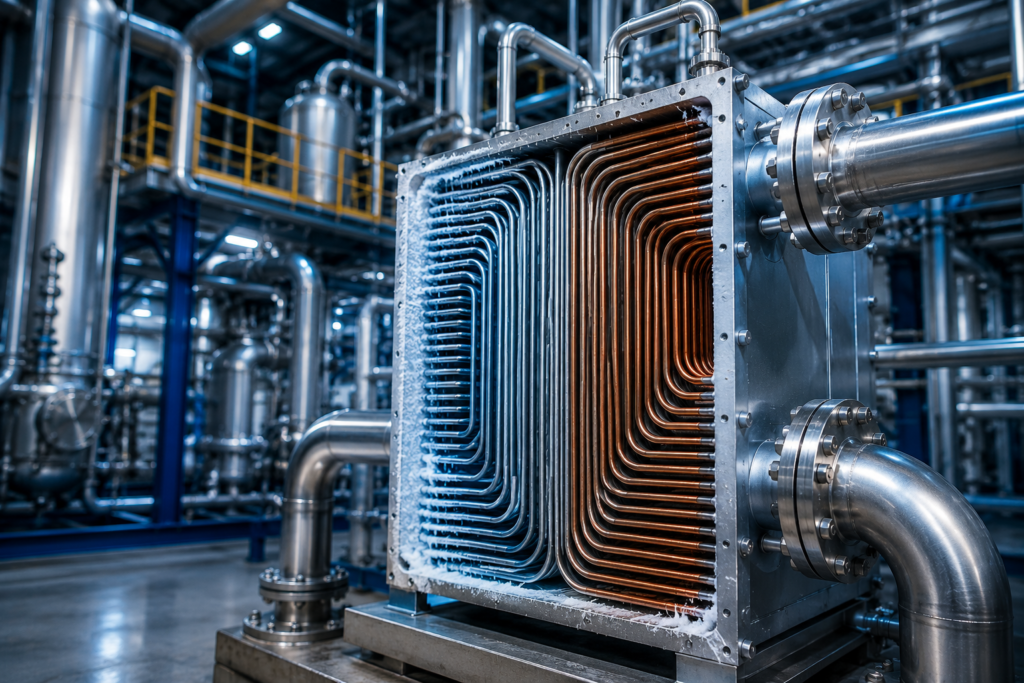
The cryogenic heat exchanger is one of the most critical components in a nitrogen plant. It enables efficient heat transfer between incoming compressed air and outgoing cold process streams, allowing the plant to achieve cryogenic temperatures required for air separation.
When heat exchanger performance deteriorates, the impact is often felt throughout the entire plant. Operators may observe reduced production, lower nitrogen purity, increasing pressure drop, unstable column operation, or higher power consumption.
The challenge is that heat exchanger problems rarely appear as a direct alarm. Instead, they often manifest through secondary process symptoms that can lead operators toward incorrect conclusions.
This guide provides a practical symptom-based troubleshooting approach for diagnosing heat exchanger-related issues in cryogenic nitrogen plants.
Effective Cryogenic Heat Exchanger Troubleshooting requires understanding how heat exchanger performance influences refrigeration recovery, nitrogen purity, production capacity, and overall cold box stability. Because many operational issues originate elsewhere in the process, a systematic troubleshooting approach is essential.
Why Heat Exchanger Performance Matters
The main heat exchanger directly influences:
- Refrigeration recovery
- Cold box efficiency
- Column thermal balance
- Nitrogen purity
- Production capacity
- Compressor energy consumption
Even a small reduction in heat exchanger effectiveness can affect overall plant performance.
This is why Cryogenic Heat Exchanger Troubleshooting plays a critical role in maintaining efficient and reliable nitrogen plant operation.
Quick Engineering Summary
Cryogenic Heat Exchanger Troubleshooting is a critical aspect of maintaining reliable operation in nitrogen generation plants. Because the main heat exchanger directly influences refrigeration recovery, column performance, nitrogen purity, and production capacity, even minor performance degradation can have plant-wide consequences.
Common issues such as moisture contamination, oil carryover, flow restrictions, and thermal imbalances often manifest through secondary symptoms including rising pressure drop, reduced production, purity fluctuations, and increased power consumption. Effective troubleshooting requires a systematic evaluation of process trends, operating conditions, and contamination sources rather than focusing solely on visible symptoms.
Successful plants treat heat exchanger performance as a key indicator of overall process health and use continuous monitoring to identify developing issues before they impact plant reliability.
Common Symptoms and Root Causes
Symptom 1: Increasing Heat Exchanger Pressure Drop
Possible Causes
- Moisture freezing inside passages
- Molecular sieve breakthrough
- Oil contamination
- Internal blockage
- Process debris
What Operators Observe
- Rising air-side pressure drop
- Higher compressor discharge pressure
- Reduced plant throughput
- Increased power consumption
One of the most common applications of Cryogenic Heat Exchanger Troubleshooting involves diagnosing increasing pressure drop caused by moisture contamination, ice formation, or internal restrictions.
Investigation Steps
Check:
- Molecular sieve regeneration performance
- Dew point trends
- Switching valve operation
- Compressor oil carryover records
- Historical pressure-drop trends
Corrective Actions
- Restore adsorber performance
- Eliminate moisture source
- Verify pretreatment system operation
- Schedule inspection if blockage is suspected
Symptom 2: Reduced Nitrogen Production
Possible Causes
- Reduced heat transfer efficiency
- Ice accumulation
- Flow maldistribution
- Heat leak into cold box
What Operators Observe
- Plant unable to reach design production
- Stable operating pressures but reduced output
- Increased specific power consumption
Investigation Steps
Review:
- Heat exchanger temperature profile
- Product flow history
- Compressor loading
- Cold-end temperature approach
During Cryogenic Heat Exchanger Troubleshooting, production losses should always be evaluated alongside temperature profiles and refrigeration performance.
Corrective Actions
- Identify contamination source
- Restore thermal efficiency
- Correct process imbalance
Symptom 3: Nitrogen Purity Fluctuation
Possible Causes
- Heat exchanger thermal imbalance
- Disturbed column refrigeration balance
- Variable air flow distribution
- Moisture ingress
What Operators Observe
- Product purity instability
- Increased analyzer fluctuations
- Frequent operator intervention
Effective Cryogenic Heat Exchanger Troubleshooting often reveals that purity fluctuations are symptoms of thermal imbalance rather than direct column problems.
Investigation Steps
Check:
- Temperature profile consistency
- Column operating conditions
- Expander performance
- Pretreatment system operation
Corrective Actions
- Stabilize upstream process conditions
- Eliminate contamination source
- Verify refrigeration balance
Symptom 4: Cold-End Temperature Deviations
Possible Causes
- Fouling
- Internal flow restriction
- Ice formation
- Heat exchanger inefficiency
Identifying abnormal temperature approaches is an important element of Cryogenic Heat Exchanger Troubleshooting because temperature deviations often provide the earliest indication of developing performance issues.
What Operators Observe
- Abnormal temperature approach
- Reduced refrigeration recovery
- Higher compressor load
Investigation Steps
Compare current temperatures with historical baseline data.
Look for:
- Progressive deterioration
- Sudden temperature changes
- Correlation with adsorber performance
Corrective Actions
- Identify contamination mechanism
- Improve moisture control
- Verify process flows
Symptom 5: Increased Compressor Power Consumption
Possible Causes
- Reduced exchanger efficiency
- Higher pressure drop
- Thermal losses
- Reduced refrigeration recovery
What Operators Observe
- Rising specific power consumption
- Higher compressor discharge pressure
- Reduced overall efficiency
Rising energy consumption is frequently investigated during Cryogenic Heat Exchanger Troubleshooting because it often indicates declining thermal efficiency.
Investigation Steps
Evaluate:
- Pressure-drop trends
- Temperature profile changes
- Production versus power consumption
Corrective Actions
- Restore exchanger performance
- Eliminate restrictions
- Investigate heat leaks
Moisture-Related Problems
Moisture contamination remains one of the most common findings during Cryogenic Heat Exchanger Troubleshooting and can significantly impact plant performance. Moisture contamination remains one of the most common causes of cryogenic heat exchanger problems.
Typical Sources
- Molecular sieve breakthrough
- Insufficient regeneration
- Adsorber valve leakage
- Moisture ingress during maintenance
Typical Symptoms
- Rising pressure drop
- Ice formation
- Production reduction
- Cold-end temperature abnormalities
Prevention
- Monitor dew point continuously
- Verify regeneration temperatures
- Maintain switching valves properly
- Follow maintenance procedures carefully
Oil Contamination Problems
Another important aspect of Cryogenic Heat Exchanger Troubleshooting involves identifying hydrocarbon contamination resulting from compressor oil carryover. Oil contamination can gradually reduce heat exchanger effectiveness.
Sources
- Compressor oil carryover
- Separator malfunction
- Filter failure
Symptoms
- Reduced thermal efficiency
- Pressure-drop increase
- Process instability
Prevention
- Maintain oil removal systems
- Monitor compressor condition
- Inspect coalescing filters regularly
Symptom-Based Troubleshooting Matrix
The following matrix can be used as a practical reference during Cryogenic Heat Exchanger Troubleshooting activities.
Symptom Likely Cause Rising pressure drop Ice formation, blockage, contamination Reduced production Thermal inefficiency, fouling Purity fluctuation Thermal imbalance, refrigeration issues High compressor power Pressure drop, reduced heat recovery Temperature deviations Fouling, moisture ingress
yOperational instability Process imbalance, exchanger degradation
Common Troubleshooting Mistakes
Successful Cryogenic Heat Exchanger Troubleshooting depends on avoiding common diagnostic errors that can delay root-cause identification.
1. Focusing Only on Visible Symptoms
Examples:
- Purity drops → operator adjusts reflux
- Pressure fluctuates → operator changes valve positions
- Production falls → operator increases compressor loading
These actions may temporarily reduce symptoms but often fail to address the underlying heat exchanger issue.
2. Excessive Manual Intervention
Frequent adjustments can create additional instability.
Cryogenic systems require time to stabilize.
Allow process changes to develop before making further corrections.
3. Ignoring Historical Trends
Many exchanger problems develop gradually.
Trend analysis often reveals:
- Progressive pressure increase
- Slowly decreasing production
- Increasing power consumption
before major operational problems become visible.
Practical Engineering Insight
One of the most important lessons in Cryogenic Heat Exchanger Troubleshooting is that the heat exchanger is often the first component to reveal a process problem rather than the actual source of the problem itself.
Operators frequently observe pressure-drop increases, production losses, or purity fluctuations and assume the exchanger is failing. However, root causes are often found upstream in the air pretreatment system, compressor oil management, molecular sieve operation, or refrigeration cycle. As a result, effective troubleshooting should always consider the entire process chain rather than focusing exclusively on the exchanger.
Plants that consistently maintain stable operation use heat exchanger trends as an early-warning diagnostic tool. Small changes in temperature approach, pressure drop, or energy consumption often provide valuable insight into developing operational problems long before major process disturbances occur.
Best Practices for Reliable Operation
Long-term success in Cryogenic Heat Exchanger Troubleshooting depends on combining trend analysis, contamination control, and disciplined operating practices.
Successful plants typically:
- Maintain excellent air pretreatment performance
- Monitor exchanger temperatures routinely
- Track pressure-drop trends
- Control compressor oil carryover
- Minimize unnecessary process disturbances
- Investigate abnormalities early
Engineering Perspective
From an engineering perspective, Cryogenic Heat Exchanger Troubleshooting should be viewed as a process optimization activity rather than simply an equipment maintenance task. The objective is not only to restore heat transfer performance but also to identify and eliminate the conditions responsible for degradation.
The most reliable heat exchangers typically operate in plants with strong contamination control, effective molecular sieve performance, disciplined operating procedures, and comprehensive trend monitoring programs. Once moisture accumulation, hydrocarbon contamination, or thermal imbalance develops within the cold section, corrective actions become more difficult and costly.
As nitrogen plants continue to pursue higher efficiency and reliability, heat exchanger performance monitoring will remain one of the most effective methods for assessing overall plant health and identifying developing process issues before they affect production or product quality.

Engineering Basis
- International Society of Automation – Control loop behavior, analyzer interaction, and process stability
- Process Control Engineering – System dynamics and feedback interactions
- National Institute of Standards and Technology – Gas property behavior under varying temperature and pressure
Conclusion & Key Takeaways
Cryogenic Heat Exchanger Troubleshooting is essential for maintaining stable, efficient, and reliable nitrogen plant operation. Because heat exchanger performance influences refrigeration recovery, column stability, nitrogen purity, and production capacity, even small performance losses can have significant operational consequences.
Successful troubleshooting requires a systematic approach that combines trend analysis, contamination control, temperature monitoring, and root-cause investigation. Rather than reacting only to visible symptoms, operators should focus on understanding how upstream process conditions affect heat exchanger performance.
By adopting a proactive troubleshooting strategy, plants can improve reliability, reduce operating costs, minimize downtime, and maintain long-term process efficiency.
Key Takeaways
- Cryogenic heat exchanger performance directly affects nitrogen purity, production capacity, and energy efficiency.
- Rising pressure drop is often an early indicator of contamination, ice formation, or flow restriction.
- Moisture contamination remains one of the most common causes of cryogenic heat exchanger problems.
- Oil carryover from compressors can reduce heat transfer efficiency and increase operational risk.
- Temperature profile deviations often indicate developing thermal or process imbalances.
- Historical trend analysis is one of the most valuable tools in cryogenic heat exchanger troubleshooting.
- Effective troubleshooting should focus on root causes rather than visible symptoms alone.
- Strong molecular sieve performance is essential for preventing moisture-related exchanger problems.
- Early intervention reduces downtime, operating costs, and production losses.
- The best troubleshooting programs combine process understanding, trend monitoring, and disciplined operational practices.
Solve Heat Exchanger Problems Before They Impact Production
Experiencing rising pressure drop, reduced nitrogen production, purity fluctuations, or unexplained increases in power consumption? These symptoms often indicate developing heat exchanger performance issues that can affect the entire nitrogen generation process.