
Low Nitrogen Purity in Cryogenic Nitrogen Plants: Causes and Troubleshooting
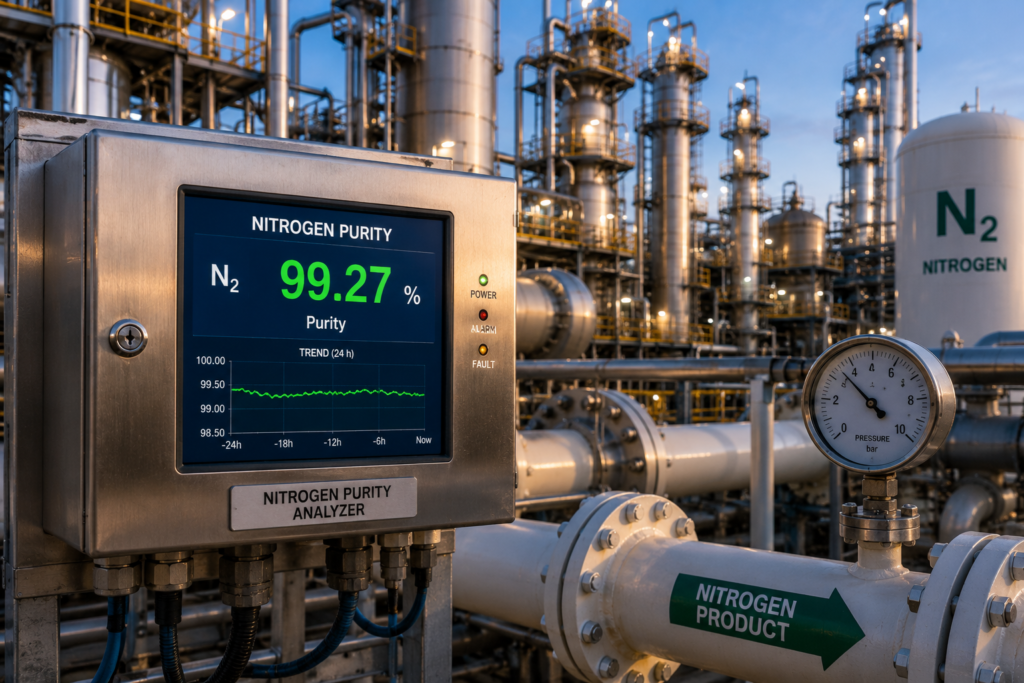
Low Nitrogen Purity is one of the most important operational challenges encountered in cryogenic nitrogen plants. Nitrogen purity directly affects product quality, customer specifications, and overall plant performance.
When Low Nitrogen Purity occurs, operators often respond by immediately adjusting reflux rates, pressure settings, or product withdrawal rates. Although these actions may temporarily improve product quality, they frequently fail to address the underlying root cause.
In most cases, Low Nitrogen Purity is not caused by a single equipment problem. Instead, it results from disturbances in distillation performance, refrigeration imbalance, contamination, heat exchanger degradation, or overall process instability.
This guide provides a systematic approach for diagnosing Low Nitrogen Purity and restoring stable operation in cryogenic nitrogen plants.
Understanding Nitrogen Purity
Nitrogen purity depends on efficient separation within the distillation column.
Several factors influence separation performance:
- Column pressure profile
- Reflux ratio
- Refrigeration balance
- Air feed conditions
- Heat exchanger performance
- Process stability
Any disturbance affecting these variables can impact product purity.
Understanding how these variables interact is essential for diagnosing Low Nitrogen Purity and maintaining stable nitrogen plant operation.
Quick Engineering Summary
Low Nitrogen Purity is usually a symptom of underlying process disturbances rather than an isolated equipment failure. Purity losses can originate from refrigeration deficiency, distillation column instability, heat exchanger degradation, moisture contamination, or process imbalance.
Effective troubleshooting requires systematic evaluation of process trends, refrigeration performance, operating conditions, and contamination sources. Plants that identify abnormalities early and focus on root-cause analysis consistently achieve higher reliability, improved product quality, and stable long-term operation.
Common Symptoms
Symptom 1: Gradual Purity Decline
Possible Causes
- Heat exchanger performance degradation
- Molecular sieve deterioration
- Refrigeration deficiency
- Process contamination
Typical Observations
- Purity slowly decreases over weeks or months
- Production may remain stable
- Power consumption gradually increases
Investigation
Gradual deterioration is one of the most common forms of Low Nitrogen Purity because performance losses often develop slowly and remain unnoticed for extended periods.
Review:
- Historical purity trends
- Heat exchanger temperatures
- Pressure-drop trends
- Dew point records
Symptom 2: Sudden Purity Drop
Possible Causes
- Process upset
- Instrument failure
- Valve malfunction
- Expander trip
- Column disturbance
Typical Observations
- Rapid purity reduction
- Stable production rate
- Unexpected analyzer readings
Investigation
Sudden Low Nitrogen Purity events usually indicate process disturbances, equipment malfunction, or instrumentation problems requiring immediate investigation.
Check:
- Recent operational changes
- Instrument calibration
- Control valve operation
- Expander status
Symptom 3: Purity Fluctuation Throughout the Day
Possible Causes
- Process instability
- Variable refrigeration
- Reflux control issues
- Frequent manual intervention
Typical Observations
- Purity oscillates around target value
- Analyzer trends show continuous variation
- Operators make repeated adjustments
Investigation
Intermittent Low Nitrogen Purity accompanied by frequent purity fluctuations often indicates refrigeration imbalance or process instability.
Review:
- Process trends
- Controller performance
- Column pressure stability
- Expander operation
Symptom 4: Low Purity with Reduced Production
Possible Causes
- Heat exchanger inefficiency
- Refrigeration deficiency
- Moisture contamination
- Distillation column imbalance
Typical Observations
- Production below design capacity
- Purity below specification
- Increased energy consumption
Investigation
Simultaneous production losses and Low Nitrogen Purity generally indicate broader process problems affecting refrigeration recovery and separation efficiency.
Evaluate:
- Heat exchanger performance
- Pressure drop
- Refrigeration generation
- Column operating conditions
Common Root Causes of Low Nitrogen Purity
Most cases of Low Nitrogen Purity originate from gradual performance degradation within the refrigeration system, heat exchanger, molecular sieve unit, or distillation column.
Reflux Imbalance
Reflux provides the liquid necessary for efficient separation.
Insufficient reflux can result in:
- Poor separation efficiency
- Increased oxygen contamination
- Reduced product purity
Refrigeration Deficiency
Distillation performance depends on adequate refrigeration.
Possible causes include:
- Expander inefficiency
- Reduced refrigeration generation
- Process imbalance
- Heat leak into the cold box
Heat Exchanger Performance Problems
Poor heat exchanger performance affects:
- Temperature profile
- Refrigeration recovery
- Column thermal balance
Common causes include:
- Moisture contamination
- Ice formation
- Oil carryover
- Internal restrictions
Molecular Sieve Breakthrough
Moisture entering the cold section can create operational problems that eventually impact purity.
Warning signs include:
- Rising pressure drop
- Temperature deviations
- Process instability
Column Instability
table column operation is essential for maintaining purity.
Potential causes:
- Pressure fluctuations
- Flow disturbances
- Excessive operator intervention
- Improper control settings
Root Cause Analysis Method
The following methodology provides a practical framework for diagnosing Low Nitrogen Purity in cryogenic nitrogen plants
Step 1: Verify Analyzer Accuracy
Before making process changes:
- Verify analyzer calibration
- Confirm sample system integrity
- Review instrument maintenance records
Step 2: Review Process Trends
Evaluate:
- Purity history
- Production rates
- Pressure profile
- Temperature profile
Trend analysis often reveals the true source of purity loss.
Step 3: Check Air Pretreatment Performance
Verify:
- Molecular sieve regeneration
- Dew point trends
- Switching valve operation
Step 4: Assess Refrigeration Balance
Review:
- Expander efficiency
- Refrigeration generation
- Cold-end temperatures
Step 5: Evaluate Distillation Performance
Check:
- Column pressures
- Reflux conditions
- Temperature distribution
- Product withdrawal rates
Common Troubleshooting Mistakes
Successful troubleshooting of Low Nitrogen Purity requires avoiding common mistakes that treat symptoms rather than identifying root causes.
Adjusting Reflux Without Understanding the Cause
Many operators immediately increase reflux when purity falls.
This may temporarily improve purity but often masks the real problem.
Excessive Manual Intervention
Frequent adjustments create additional instability and complicate troubleshooting.
Cryogenic systems require time to respond to changes.
Ignoring Historical Data
Most purity problems develop gradually.
Historical trends frequently reveal:
- Performance degradation
- Refrigeration decline
- Increasing contamination
before major purity losses occur.
Practical Engineering Insight
One of the most important lessons from investigating Low Nitrogen Purity is that operators often focus on correcting purity values instead of understanding why purity has deteriorated. Increasing reflux or adjusting pressure settings may temporarily improve product quality but frequently masks the actual problem.
In many cases, Low Nitrogen Purity is an early indication of deteriorating refrigeration balance, increasing contamination, declining heat exchanger performance, or developing column instability. Historical trends often reveal these issues long before major operational disturbances become visible.
Plants that consistently maintain specification treat purity trends as an important indicator of overall process health rather than simply a product quality measurement.
Best Practices for Maintaining High Purity
Long-term prevention of Low Nitrogen Purity depends on continuous monitoring, contamination control, and disciplined operating practices.
Plants that consistently achieve specification typically:
- Maintain excellent molecular sieve performance
- Monitor heat exchanger temperatures
- Track purity trends continuously
- Minimize unnecessary process disturbances
- Investigate abnormalities early
- Follow disciplined operating procedures
Engineering Perspective
From an engineering perspective, Low Nitrogen Purity should be viewed as a plant-wide performance issue rather than a distillation column problem alone. Nitrogen purity depends on the integrated performance of air pretreatment systems, refrigeration generation, heat exchangers, process control systems, and separation equipment.
The most reliable plants maintain high product purity because they continuously monitor performance trends, maintain contamination control, and investigate abnormalities early. Small changes in pressure profiles, temperature distributions, refrigeration balance, or heat exchanger performance often provide early warning signs of developing purity problems.
As cryogenic nitrogen plants continue to pursue higher efficiency and reliability, systematic troubleshooting of Low Nitrogen Purity becomes an essential component of operational excellence and long-term plant performance.
Related Engineering Insights
- Process Instability in Cryogenic Nitrogen Plants
- Cryogenic Heat Exchanger Icing in Nitrogen Plants
- Nitrogen Purity Fluctuation in Cryogenic Plants
- Cryogenic Heat Exchanger Troubleshooting Guide
- Cold Box Troubleshooting Guide
- Low Nitrogen Production in Cryogenic Nitrogen Plants
- Moisture Contamination in Cryogenic Nitrogen Plants
- Distillation Column Instability in Cryogenic Nitrogen Plants
- Maintenance of Cryogenic Heat Exchangers in Nitrogen Plants

Engineering Basis
- International Society of Automation – Control loop behavior, analyzer interaction, and process stability
- Process Control Engineering – System dynamics and feedback interactions
- National Institute of Standards and Technology – Gas property behavior under varying temperature and pressure
Conclusion & Key Takeaways
Low Nitrogen Purity is usually the result of gradual performance degradation within the refrigeration system, heat exchanger, distillation columns, or air pretreatment system rather than an isolated equipment problem.
Effective troubleshooting of Low Nitrogen Purity requires a systematic approach that combines trend analysis, contamination control, refrigeration assessment, and root-cause identification. By focusing on underlying process conditions instead of reacting only to visible symptoms, plant operators can restore product quality, improve reliability, and maintain stable long-term plant performance.
Key Takeaways
- Low Nitrogen Purity is usually a symptom of deeper process problems rather than a single equipment failure.
- Refrigeration imbalance and distillation instability are among the most common causes of purity loss.
- Heat exchanger degradation can indirectly affect nitrogen purity through reduced refrigeration recovery.
- Moisture contamination can significantly disrupt cold box operation and separation efficiency.
- Historical trend analysis is one of the most valuable tools for diagnosing Low Nitrogen Purity.
- Excessive manual intervention often increases process instability and complicates troubleshooting.
- Maintaining molecular sieve performance is essential for preventing contamination-related purity problems.
- Early investigation of abnormalities improves reliability, reduces downtime, and maintains product quality.
- Systematic root-cause analysis is the most effective approach for restoring and maintaining nitrogen purity.
Maintain Purity. Improve Stability. Protect Plant Performance.
Low nitrogen purity is often the first visible sign of deeper process issues such as refrigeration imbalance, heat exchanger degradation, moisture contamination, or distillation column instability. Reacting only to analyzer readings may temporarily improve product quality but rarely resolves the underlying problem.
Access practical engineering resources and troubleshooting guides designed to help you diagnose purity problems, identify root causes, and maintain stable long-term plant performance.
.