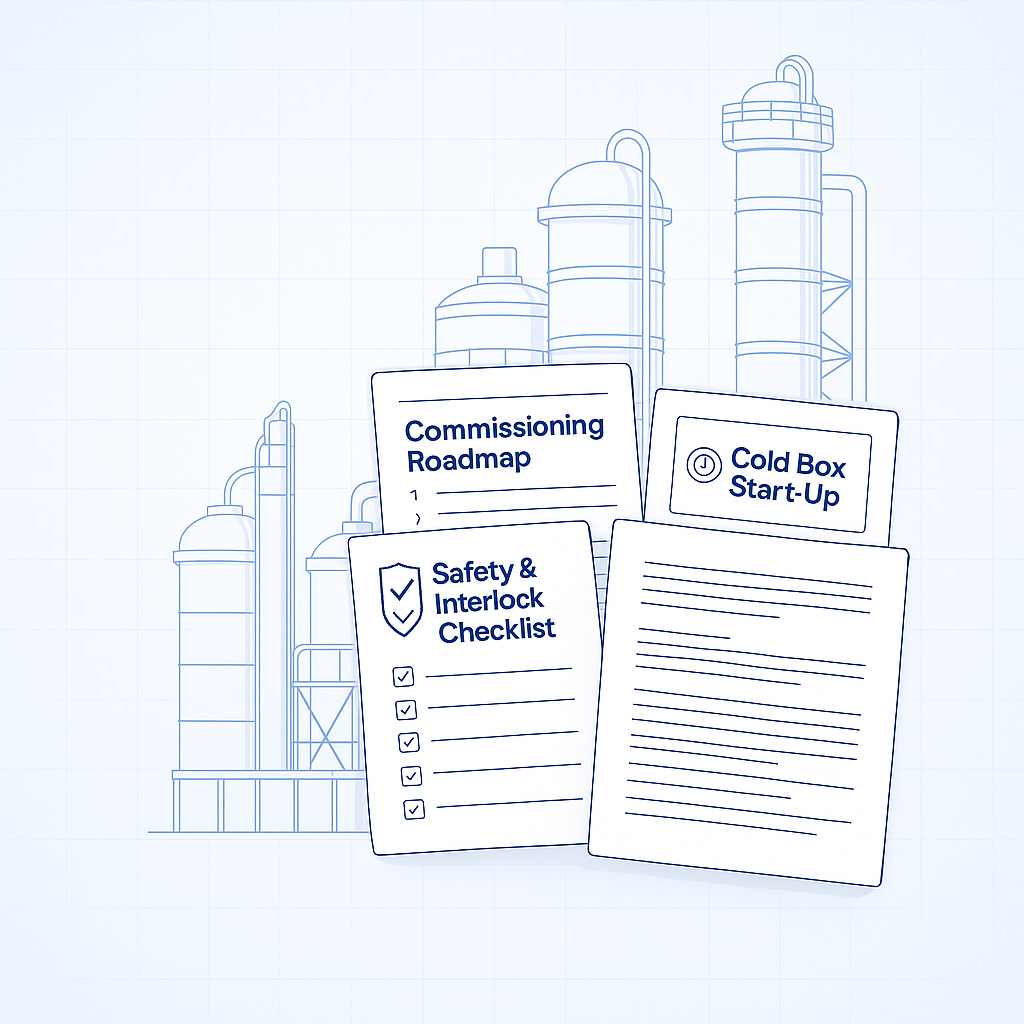
Cryogenic Nitrogen Plant Commissioning Toolkit

A structured engineering system to plan, execute, and stabilize plant startup β€” without trial-and-error.

βœ” Step-by-step commissioning workflow
βœ” Prevent startup failures and delays
βœ” Achieve stable operation faster

πŸ‘‰ Built for real plant commissioning conditions β€” not theory

β€œTrusted by commissioning engineers working across air separation units, cryogenic systems, and industrial gas plants.”

Cryogenic Nitrogen Plant Commissioning Toolkit

Why Commissioning Fails in Cryogenic Nitrogen Plants

Commissioning is the most critical phase in any cryogenic nitrogen plant β€” yet most failures originate here.

It is the transition from construction to live operation, where small mistakes lead to major operational problems.

  • Without a structured commissioning approach:

    • Equipment damage during startup
    • Process instability and oscillations
    • Delayed nitrogen purity achievement
    • Increased operational risk
    • Repeated troubleshooting cycles

    πŸ‘‰ Most problems don’t start during operation β€” they start during commissioning

Real Plant Scenario

A plant completes installation successfully.

During startup:

  • Cooling sequence is rushed
  • Control loops are not tuned properly
  • Purification system stabilization is incomplete

πŸ‘‰ The plant starts… but becomes unstable.


What happens next?

  • Purity fluctuates
  • Trips begin
  • Troubleshooting increases

πŸ‘‰ The real issue was not operation β€”
it was poor commissioning sequence and validation


πŸ‘‰ This is exactly where the
cryogenic nitrogen plant commissioning toolkit becomes essential.

A Structured Cryogenic Nitrogen Plant Commissioning Toolkit

Commissioning a cryogenic nitrogen plant involves multiple systems β€” compressors, purification, cold box, turbines, and controls.

Missed checks, unclear sequences, or incomplete verification often lead to startup delays, unstable purity, and repeated shutdowns.

The cryogenic nitrogen plant commissioning toolkit provides a systematic, step-by-step engineering framework to ensure safe, stable, and efficient plant startup.

Instead of reactive corrections, it enables:

βœ” Controlled startup sequencing
βœ” Proper system validation
βœ” Smooth transition to stable operation

Why this toolkit works:

  • Built for real plant commissioning scenarios
  • Focused on execution, not theory
  • Designed to prevent failures before they occur
  • Structured as a modular engineering workflow

πŸ‘‰ It transforms commissioning from
trial-and-error β†’ structured execution

For post-startup performance issues and fault diagnosis, teams typically use a structured Cryogenic Nitrogen Plant Troubleshooting Toolkit.

  • πŸ‘‰ Commissioning success depends on controlβ€”not speed

What You Get:

A complete engineering system designed for real plant commissioning.

βœ” Complete commissioning framework (step-by-step system)
βœ” 7 detailed engineering modules
βœ” Visual workflows & commissioning diagrams
βœ” Practical validation checklists
βœ” Field-proven engineering insights

πŸ‘‰ Learn fundamentals before using toolkit:
πŸ‘‰ Explore Cryogenic Engineering Insights (internal link)

What’s Included in the Cryogenic Nitrogen Plant Commissioning Toolkit

This cryogenic nitrogen plant commissioning toolkit includes 7 structured modules covering every stage of plant startup. These are the exact documents used by EPC contractors, commissioning managers, and cryogenic process engineers.

Commissioning Framework

Defines overallΒ commissioning structureΒ and sequencing

Pre-Commissioning Inspection

Ensures system readiness and mechanical integrity

Instrumentation & Control Checks

Validates control systems and safety interlocks

Molecular Sieve
Startup

Ensures properΒ air purificationΒ and adsorber performance

Cold Box Cooldown Procedure

Controls temperature reduction and prevents thermal stress

Plant Startup & Stabilization

Guides transition intoΒ stable plant operation

Each module includes:

  • Process understanding
  • Key control points
  • Operational approach
  • Field insights
  • Practical checklists

How Engineering Teams Use the Cryogenic Nitrogen Plant Commissioning Toolkit

Step 1 β€” Plan &
Schedule

Define system pre-checks, assign responsibility owners, and map commissioning gates.

Step 2 β€” Execute Field Checklists

Technicians use laminated 1-page sheets for quick on-site verification.

Step 3 β€” Handover to Operations

Use the standardized pack to ensure clean and complete transfer of knowledge.

β€œHandling live plant instability? Use theΒ Troubleshooting ToolkitΒ β†’Β 

Safety verification and interlock validation are also covered in detail in our Cryogenic Nitrogen PlantΒ Safety & Compliance Toolkit.

What You Gain

βœ” Reduced startup risk
βœ” Faster commissioning completion
βœ” Improved nitrogen purity stability
βœ” Fewer operational issues post-startup
βœ” Confidence in commissioning decisions

πŸ‘‰ Stability is built during commissioning β€” not corrected later

Built for Real-World Commissioning

Unlike generic guides, this
cryogenic nitrogen plant commissioning toolkit focuses on:

  • Real plant behavior
  • Sequence-based execution
  • Failure prevention β€” not correction

Key Advantages:

  • Sequence-driven commissioning approach
  • Prevents early-stage errors that escalate later
  • Reduces trial-and-error startup
  • Improves operational stability
  • Achieves faster steady-state operation

πŸ‘‰ Stability is built progressivelyβ€”not corrected later

After Commissioning, What Next?

Even well-commissioned plants face operational challenges.

For diagnosing real plant issues, use:

πŸ‘‰ Cryogenic Nitrogen Plant Troubleshooting Toolkit

πŸ‘‰ Also explore:

  • Nitrogen purity fluctuations
  • Cold box freezing
  • Molecular sieve failures

Who This Toolkit Is For

Engineers

Speed up diagnosis, avoid mistakes, understand real plant behavior.

Plant Managers

Ensure predictable purity, reduce downtime, improve performance.

Consultants

Deliver better reports, structured insights, client confidence.

Students

Bridge theory-to-field gap with logical flowcharts & real case learning.

If you are responsible for successful startup and handover of a nitrogen plant, this Cryogenic Nitrogen Plant commissioning toolkit is built for your workflow.

How This Toolkit Fits in the Complete Plant Performance System

Commissioning is not just the starting point of a cryogenic nitrogen plant.

It defines how the plant will behave during operation, stability, and long-term performance.

πŸ‘‰ Most plant problems do not originate during operation.
πŸ‘‰ They originate during commissioning.

Safety ensures readiness.
Commissioning builds the foundation.
Stability controls operation.
Optimization improves performance.

πŸ‘‰ Together, they create a reliable, predictable plant system

Errors introduced during commissioning:

  • Propagate into operation
  • Create recurring instability
  • Increase troubleshooting complexity
  • Reduce overall plant efficiency

πŸ‘‰ A well-executed commissioning phase reduces up to 80% of future operational issues

Start with a structured commissioning approach β€” and build a stable, efficient plant from day one.

Start with the Right Stage

If you are in startup phase:

πŸ‘‰ Begin with the Cryogenic Nitrogen Plant Commissioning Toolkit

If your plant is already running but unstable:

πŸ‘‰ Move to Stability or Troubleshooting Toolkits

If your plant is stable but inefficient:

πŸ‘‰ Use the Performance Optimization Toolkit

cryogenic nitrogen plant commissioning checklist

Get the Complete Commissioning Toolkit

β‚Ή 799

Instant Digital Download β€’ Lifetime Free Updates

πŸ›‘ 100% Engineer-Friendly. No fluff.

Optional Add-ons

βœ” Remote consulting

βœ” Document review

βœ” Discount when purchased with Troubleshooting Pack

βœ” Available separately. Not required to use the toolkit.

Startup Success Bundle

Most commissioning teams also use safety and stability documentation during startup.

Includes:

  • Commissioning Toolkit

  • Safety Toolkit

  • Stability Toolkit

Understand the Problem Before You Apply the Toolkit

Why Most Commissioning Issues Are Not Visible Immediately

Commissioning problems do not always appear during startup.

They develop silently β€” through incomplete checks, incorrect sequencing, or improper system validation β€” and become visible only later during operation.

πŸ‘‰ What appears as instability, trips, or purity issues often originates during commissioning.

Common Misconceptions During Commissioning

Many teams assume:

  • If the plant starts, commissioning is successful
  • If parameters are within range, the system is stable
  • If no immediate issues occur, the plant is ready for operation

πŸ‘‰ These assumptions lead to hidden problems that surface later as:

  • Process instability and operational fluctuation
  • Frequent plant trips
  • Nitrogen purity inconsistency
  • Increased energy consumption

What Actually Happens in Real Plants

In cryogenic nitrogen plants, systems are interconnected.

A small deviation during commissioning β€” such as:

  • Improper molecular sieve activation
  • Incomplete interlock validation
  • Incorrect cooldown sequence
  • Instrumentation mismatch

πŸ‘‰ Can propagate into multiple operational issues.

Build Engineering Understanding Before Commissioning

Before applying a structured commissioning approach, it is important to understand how systems behave during startup and early operation.

Recommended Engineering Insights

  • πŸ‘‰ Startup Instability in Cryogenic Nitrogen Plants
  • πŸ‘‰ Common Causes of Cryogenic Nitrogen Plant Trips
  • πŸ‘‰ Why Nitrogen Plant Purity Fluctuates

Supporting Engineering Guides

  • πŸ‘‰ Cryogenic Nitrogen Plant Commissioning – Practical Engineering Guide
  • πŸ‘‰ Cryogenic Nitrogen Plant Operations – Complete Engineering Guide
  • πŸ‘‰ Molecular Sieve Systems in Cryogenic Nitrogen Plants

Apply Structured Commissioning After Understanding

Once you understand how commissioning deviations affect plant behavior,
you can apply a systematic approach using the:

πŸ‘‰ Cryogenic Nitrogen Plant Commissioning Toolkit

This helps you:

βœ” Execute controlled startup procedures
βœ” Validate system performance accurately
βœ” Prevent hidden issues from entering operation
βœ” Build a stable foundation for plant performance

πŸ‘‰ Commissioning is not about starting the plant.
πŸ‘‰ It is about starting it correctly.

Need Project-Specific Engineering Support?

If your site has complex process conditions or tight schedules, we also provide commissioning and stabilization consulting support.

Start Commissioning with Confidence

Commissioning is not about speed β€”
it is about control, sequence, and validation.

This toolkit helps you:

  • Avoid costly startup mistakes
  • Build stable plant operation from day one
  • Reduce future troubleshooting

πŸ‘‰ Stop reactive commissioning
πŸ‘‰ Start structured plant startup

FAQ

1. What is the Cryogenic Nitrogen Plant Commissioning Toolkit?

Cryogenic Nitrogen Plant Commissioning Toolkit is a complete set of commissioning checklists, SOPs, cold box start-up guides, equipment verification sheets, and handover templates used to streamline commissioning of ASU and cryogenic nitrogen plants.

2. Who uses this Cryogenic Nitrogen Plant Commissioning Toolkit?

EPC companies, commissioning engineers, plant start-up teams, and O&M teams working across industrial gas plants, nitrogen generators, and air separation units.

3. Is this Cryogenic Nitrogen Plant Commissioning Toolkit suitable for ASU oxygen–nitrogen plants?

Yes. The toolkit is built for cryogenic air separation systems, nitrogen/oxygen production units, and large tonnage cryogenic facilities.

4. Do I get editable source files?

Yesβ€”Team and Enterprise licenses include fully editable files (Word, Excel, PDF, etc.).

5. Can this Cryogenic Nitrogen Plant Commissioning Toolkit reduce commissioning delays?

Absolutely. Following structured checklists and SOPs ensures faster purity recovery, fewer instrument faults, and fewer deviations during start-up.

More on air separation fundamentals β†’ https://www.energy.gov

Disclaimer

This publication is provided for educational training and general engineering reference purposes only.

It does not replace:

  • OEM manuals or design documentation

  • Plant-specific operating procedures (SOPs)

  • Qualified engineering judgment, supervision, or site safety regulations

All values, limits, sequences, and examples shown are typical reference practices and may vary by plant design, OEM, operating conditions, and regulatory requirements.

Users must verify all parameters, settings, and procedures with:

  • OEM manuals

  • Site-approved documentation

  • Applicable safety and regulatory standards

Procedural steps and troubleshooting methods described herein are illustrative and must be executed only by trained and authorized personnel following site safety rules.

The publisher and authors disclaim any liability for loss, damage, injury, or operational impact arising from the use, application, or interpretation of this material.

Unauthorized reproduction, resale, or public distribution of this content is strictly prohibited.

Scroll to Top