
Cold Box Troubleshooting Guide: Symptoms, Causes, and Solutions
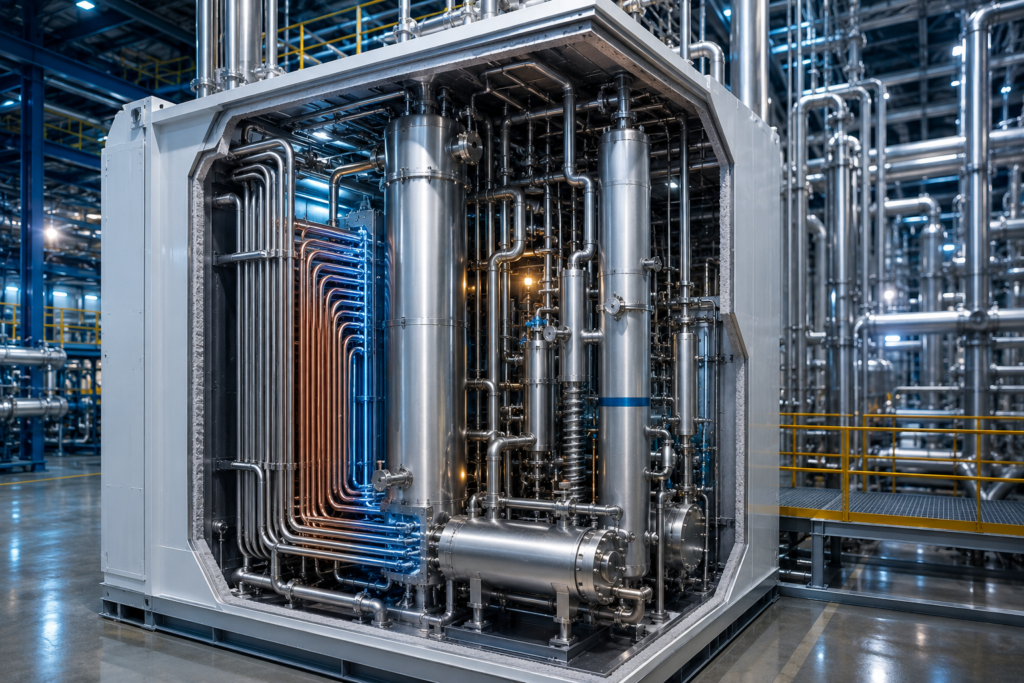
The cold box is the heart of a cryogenic nitrogen plant. It houses the main heat exchanger, distillation columns, associated piping, and critical process equipment operating at extremely low temperatures.
This Cold Box Troubleshooting Guide is designed to help operators and engineers systematically diagnose cold box performance issues and identify their underlying causes before they impact plant reliability.
Because multiple systems interact inside the cold box, operational problems can be difficult to diagnose. A purity issue may appear to originate in the distillation column, while the actual root cause lies in moisture contamination, refrigeration imbalance, or heat exchanger degradation.
Effective troubleshooting requires a systematic approach focused on identifying root causes rather than reacting only to visible symptoms.
Why Cold Box Performance Is Important
The cold box directly affects:
- Nitrogen purity
- Production capacity
- Refrigeration balance
- Energy efficiency
- Process stability
- Plant reliability
Small deviations can quickly affect overall plant performance.
Understanding the relationship between these parameters is fundamental to effective Cold Box Troubleshooting Guide practices.
Quick Engineering Summary
The Cold Box Troubleshooting Guide provides a systematic approach for diagnosing operational issues in cryogenic nitrogen plants. Because the cold box contains the main heat exchanger, distillation columns, refrigeration systems, and associated process equipment, problems rarely originate from a single source.
Symptoms such as reduced production, nitrogen purity fluctuations, increasing pressure drop, process instability, or unexpected PSV lifting are often interconnected. Effective troubleshooting requires trend analysis, contamination control, refrigeration assessment, and root-cause investigation rather than simply reacting to visible symptoms.
Successful plants use a structured troubleshooting methodology to identify developing issues early, maintain process stability, and improve long-term plant reliability.
Common Symptoms
Symptom 1: Reduced Nitrogen Production
Possible Causes
- Heat exchanger inefficiency
- Refrigeration deficiency
- Moisture contamination
- Expander performance issues
- Air flow restrictions
Typical Observations
- Production below design capacity
- Increased compressor loading
- Stable purity but reduced output
Investigation
One of the most common applications of a Cold Box Troubleshooting Guide is identifying the factors responsible for production losses in cryogenic nitrogen plants.
Check:
- Main heat exchanger temperatures
- Expander operating parameters
- Column pressure profile
- Pressure drop trends
Symptom 2: Nitrogen Purity Fluctuation
Possible Causes
- Reflux imbalance
- Distillation column instability
- Refrigeration variation
- Heat exchanger degradation
Typical Observations
- Analyzer fluctuations
- Product specification excursions
- Frequent operator adjustments
Investigation
During Cold Box Troubleshooting Guide activities, purity fluctuations should be evaluated alongside refrigeration balance and column operating conditions.
Review:
- Column differential pressures
- Temperature profile
- Reflux conditions
- Product demand changes
Symptom 3: Increasing Pressure Drop
Possible Causes
- Ice accumulation
- Moisture ingress
- Internal restriction
- Contamination
Typical Observations
- Higher compressor discharge pressure
- Reduced throughput
- Increased power consumption
Investigation
Rising pressure drop is a frequent issue addressed in any Cold Box Troubleshooting Guide because it often indicates contamination or developing flow restrictions.
Verify:
- Molecular sieve performance
- Dew point trends
- Switching valve operation
- Historical pressure-drop records
Symptom 4: Process Instability and Operational Fluctuation
Possible Causes
- Variable refrigeration balance
- Expander hunting
- Process disturbances
- Excessive manual intervention
Typical Observations
- Oscillating pressures
- Temperature swings
- Frequent controller corrections
Investigation
A structured Cold Box Troubleshooting Guide helps engineers identify the root causes of process instability rather than repeatedly adjusting operating parameters.
Evaluate:
- Control loop performance
- Expander trends
- Recent process changes
- Instrument reliability
Symptom 5: Unexpected PSV Lifting
Possible Causes
- Pressure buildup
- Blocked passages
- Operational upset
- Improper valve operation
Typical Observations
- Intermittent PSV lifting
- Column pressure spikes
- Process disturbances
Investigation
Unexpected PSV lifting events require immediate evaluation using a systematic Cold Box Troubleshooting Guide approach.
Check:
- Pressure trends before PSV activation
- Valve sequencing
- Flow restrictions
- Column operating conditions
Moisture Contamination Problems
Moisture contamination remains one of the most common findings encountered during Cold Box Troubleshooting Guide investigations.
Moisture entering the cold box is one of the most serious operational threats.
Common Sources
- Molecular sieve breakthrough
- Insufficient regeneration
- Valve leakage
- Maintenance-related ingress
Typical Consequences
- Ice formation
- Increasing pressure drop
- Reduced production
- Process instability
Refrigeration Deficiency Problems
Refrigeration-related issues are frequently identified during Cold Box Troubleshooting Guide activities because refrigeration balance directly affects plant performance.
Inadequate refrigeration can affect every section of the cold box.
Potential Causes
- Expander inefficiency
- Process imbalance
- Excessive heat leak
- Reduced heat exchanger performance
Typical Symptoms
- Production loss
- Purity reduction
- Temperature profile deviations
Root Cause Troubleshooting Approach
The following methodology forms the foundation of an effective Cold Box Troubleshooting Guide for cryogenic nitrogen plants.
Step 1: Identify the primary symptom.
Examples:
- Low production
- Purity fluctuation
- Pressure instability
- PSV lifting
Step 2: Review historical trends.
Compare:
- Temperatures
- Pressures
- Production rates
- Purity values
Step 3: Verify air pretreatment performance.
Check:
- Molecular sieve regeneration
- Dew point trends
- Valve sequencing
Step 4: Investigate refrigeration balance.
Evaluate:
- Expander performance
- Heat exchanger effectiveness
- Column operating conditions
Step 5: Confirm root cause before making major process changes.
Common Troubleshooting Mistakes
A successful Cold Box Troubleshooting Guide not only identifies problems but also helps operators avoid common diagnostic mistakes.
Treating Symptoms Instead of Causes
Examples:
- Adjusting reflux repeatedly
- Changing pressure setpoints
- Increasing compressor load
without identifying the underlying problem.
Excessive Manual Intervention
Frequent adjustments often increase instability and make troubleshooting more difficult.
Ignoring Trend Data
Most cold box problems develop gradually and become visible in historical operating data before major symptoms appear.
Practical Engineering Insight
One of the most important lessons from any Cold Box Troubleshooting Guide is that the visible symptom is rarely the actual problem. Operators often focus on purity fluctuations, pressure instability, or production losses, while the root cause may originate from moisture contamination, refrigeration imbalance, molecular sieve performance, or heat exchanger degradation.
Effective Cold Box Troubleshooting Guide practices require engineers to evaluate the complete process chain rather than individual equipment items. Historical trends, temperature profiles, pressure-drop data, and refrigeration performance often provide clearer indications of developing problems than real-time operating conditions alone.
Plants that consistently achieve stable operation treat troubleshooting as a diagnostic process focused on identifying root causes rather than continuously adjusting operating parameters.
Best Practices
Long-term success with any Cold Box Troubleshooting Guide depends on proactive monitoring, contamination control, and disciplined operating practices.
- Maintain excellent molecular sieve performance
- Monitor heat exchanger temperature profiles
- Trend pressure-drop data regularly
- Investigate abnormalities early
- Minimize unnecessary process disturbances
- Follow disciplined startup and shutdown procedures
Engineering Perspective
From an engineering perspective, a Cold Box Troubleshooting Guide should be viewed as a process optimization tool rather than simply a troubleshooting document. The objective is not only to resolve immediate operational issues but also to understand the interactions between heat exchangers, distillation columns, refrigeration systems, and air pretreatment equipment.
The most reliable cryogenic nitrogen plants are typically those that investigate abnormal trends early, maintain strict contamination control, and minimize unnecessary process disturbances. In many cases, small changes in temperature approach, pressure drop, purity, or energy consumption provide early warning signs of developing cold box problems.
As plants pursue higher efficiency and reliability, the value of a structured Cold Box Troubleshooting Guide extends beyond problem solving and becomes an essential part of long-term operational excellence.
Related Engineering Insights
For more detailed diagnostics, use this Cold Box Troubleshooting Guide together with the following engineering resources.
- Process Instability in Cryogenic Nitrogen Plants
- Cryogenic Heat Exchanger Icing in Nitrogen Plants
- Nitrogen Purity Fluctuation in Cryogenic Plants
- Cryogenic Heat Exchanger Troubleshooting Guide
- Maintenance of Cryogenic Heat Exchangers in Nitrogen Plants
- Moisture Contamination in Cryogenic Nitrogen Plants
- Low Nitrogen Production in Cryogenic Nitrogen Plants
- Low Nitrogen Purity in Cryogenic Nitrogen Plants
- Distillation Column Instability in Cryogenic Nitrogen Plants

Engineering Basis
- International Society of Automation – Control loop behavior, analyzer interaction, and process stability
- Process Control Engineering – System dynamics and feedback interactions
- National Institute of Standards and Technology – Gas property behavior under varying temperature and pressure
Conclusion & Key Takeaways
The Cold Box Troubleshooting Guide is an essential resource for maintaining stable and reliable operation in cryogenic nitrogen plants. Because the cold box integrates heat exchangers, distillation columns, refrigeration systems, and process piping, operational problems often involve multiple interacting factors.
Successful troubleshooting requires a disciplined, root-cause-focused approach that combines trend analysis, process understanding, contamination control, and refrigeration assessment. Rather than reacting only to visible symptoms, engineers should focus on identifying the underlying causes of performance degradation.
By following the principles outlined in this Cold Box Troubleshooting Guide, plant operators can improve process stability, maximize production, maintain product purity, and enhance overall plant reliability.
Key Takeaways
✅ The Cold Box Troubleshooting Guide helps identify root causes behind production losses, purity fluctuations, pressure increases, and process instability.
✅ Cold box problems often result from interactions between multiple systems rather than a single equipment failure.
✅ Moisture contamination remains one of the most common causes of cold box performance degradation.
✅ Heat exchanger performance directly affects refrigeration recovery, production capacity, and nitrogen purity.
✅ Expander instability can create significant refrigeration imbalance and operational fluctuations.
✅ Historical trend analysis is one of the most valuable tools in cold box troubleshooting.
✅ Excessive manual intervention often increases process instability and delays root-cause identification.
✅ Molecular sieve reliability plays a critical role in preventing moisture-related cold box problems.
✅ Early investigation of abnormal operating conditions helps reduce downtime and maintenance costs.
✅ A structured troubleshooting methodology improves plant reliability, efficiency, and long-term operational stability.
Improve Cold Box Performance and Plant Stability
Experiencing purity fluctuations, production losses, increasing pressure drop, or refrigeration instability? Many cold box issues develop gradually and become easier to resolve when identified early.
Access practical engineering resources, troubleshooting guides, and operational best practices designed to help engineers diagnose root causes, improve plant performance, and maintain reliable operation.