
Cold Box Operation in Cryogenic Nitrogen Plants: Principles, Performance, and Best Practices
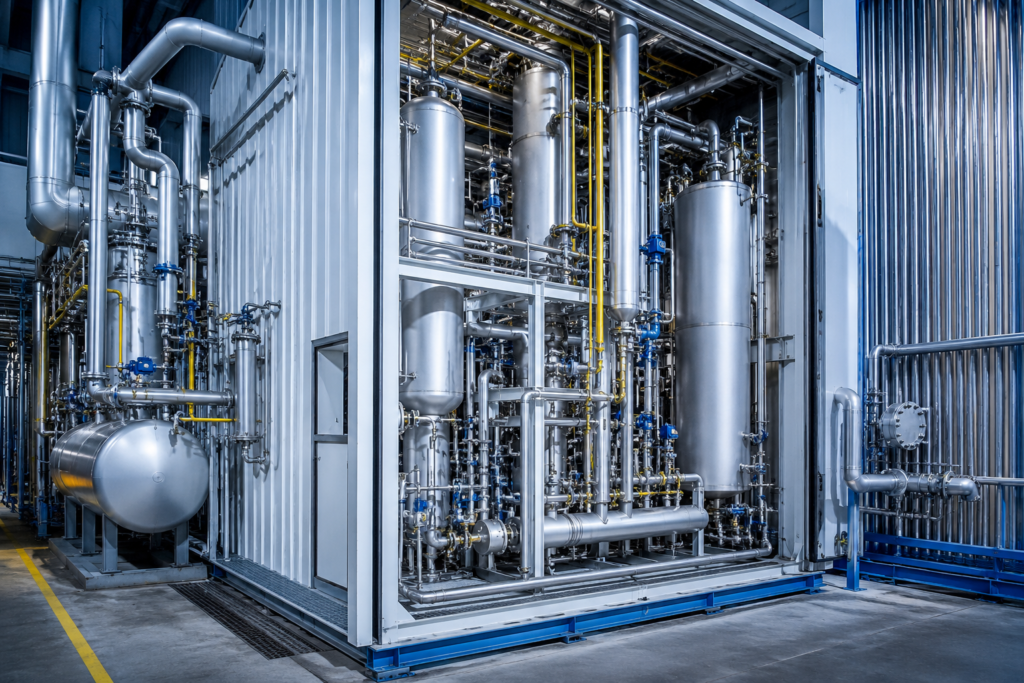
Cold Box Operation in Cryogenic Nitrogen Plants is fundamental to the performance and reliability of a nitrogen generation plant. The cold box houses the main heat exchanger, distillation columns, associated piping, and critical process equipment operating at extremely low temperatures. It is the primary location where refrigeration recovery, heat transfer, and air separation take place.
Successful Cold Box Operation in Cryogenic Nitrogen Plants requires maintaining thermal balance, stable refrigeration, proper pressure profiles, and efficient separation conditions. Because multiple systems interact within the cold box, even minor disturbances can affect nitrogen purity, production capacity, energy consumption, and overall plant stability.
Many operational problems, including purity fluctuations, production losses, increasing pressure drop, and process instability, can often be traced to abnormalities in Cold Box Operation in Cryogenic Nitrogen Plants. Understanding the principles of cold box operation and recognizing early warning signs are essential for maintaining reliable, efficient, and stable plant performance.
What Is a Cryogenic Cold Box?
Effective Cold Box Operation in Cryogenic Nitrogen Plants directly influences nitrogen purity, production capacity, refrigeration efficiency, energy consumption, and overall plant reliability. Even minor disturbances within the cold section can affect the performance of the entire nitrogen generation process.
A cryogenic cold box is an insulated enclosure that houses the low-temperature equipment of a cryogenic nitrogen plant.
The cold box typically contains:
- Main heat exchanger
- High-pressure and low-pressure distillation columns
- Product vaporizers
- Associated cryogenic piping
- Temperature and pressure instrumentation
- Product withdrawal systems
The cold box minimizes heat leakage from the environment while maintaining the extremely low temperatures required for air separation.
Why Cryogenic Cold Box Operation Is Critical
Effective Cold Box Operation in Cryogenic Nitrogen Plants directly influences nitrogen purity, production capacity, refrigeration efficiency, energy consumption, and overall plant reliability. Even minor disturbances within the cold section can affect the performance of the entire nitrogen generation process.
Effective Cryogenic Cold Box Operation directly influences:
- Nitrogen purity
- Production capacity
- Refrigeration efficiency
- Energy consumption
- Process stability
- Equipment reliability
Any disturbance inside the cold box can affect overall plant performance.
Typical consequences include:
- Reduced nitrogen production
- Product purity fluctuations
- Higher compressor power consumption
- Process instability
- Increased operational risk
Quick Engineering Summary
Cold Box Operation in Cryogenic Nitrogen Plants is fundamental to the performance, efficiency, and reliability of nitrogen generation plants. The cold box integrates refrigeration recovery, heat transfer, and air separation processes within a highly controlled cryogenic environment.
Stable operation depends on maintaining thermal balance, proper pressure profiles, adequate refrigeration, and effective contamination control. Disturbances such as moisture ingress, heat exchanger degradation, refrigeration deficiency, or column instability can quickly affect nitrogen purity, production capacity, and energy efficiency.
Successful Cryogenic Cold Box Operation requires continuous monitoring, disciplined operating practices, and early investigation of abnormal process conditions to ensure long-term plant stability and reliability.
Major Functions of the Cold Box
Refrigeration Recovery
The main heat exchanger recovers refrigeration from outgoing cold streams and transfers it to incoming compressed air.
Efficient refrigeration recovery:
- Reduces energy consumption
- Maintains thermal balance
- Supports stable operation
- Improves plant efficiency
Efficient refrigeration recovery is one of the fundamental requirements of stable Cold Box Operation in Cryogenic Nitrogen Plants, as it directly affects thermal balance and plant efficiency.
Distillation and Air Separation
Successful Cold Box Operation in Cryogenic Nitrogen Plants depends on maintaining stable separation conditions inside the distillation columns.
The distillation columns inside the cold box separate air components based on boiling point differences.
Stable separation requires:
- Proper reflux conditions
- Stable column pressures
- Adequate refrigeration
- Controlled product withdrawal
Thermal Balance Management
The cold box functions as an integrated thermal system.
Cryogenic Cold Box Operation depends on maintaining:
- Temperature profiles
- Pressure profiles
- Refrigeration balance
- Stable process flows
Because the cold box operates as an integrated thermal system, even small disturbances can significantly affect Cold Box Operation in Cryogenic Nitrogen Plants and overall plant stability.
Key Operating Parameters
Main Heat Exchanger Temperatures
Continuous monitoring of heat exchanger temperatures is essential for reliable Cold Box Operation in Cryogenic Nitrogen Plants because temperature deviations often indicate developing process abnormalities.
Operators should monitor:
- Warm-end temperatures
- Cold-end temperatures
- Temperature approach
- Temperature profile consistency
Abnormal temperatures often indicate:
- Moisture contamination
- Heat leaks
- Flow restrictions
- Process imbalance
Column Pressure Profile
Column pressure directly influences separation performance.
Operators should monitor:
- High-pressure column pressure
- Low-pressure column pressure
- Differential pressure
- Pressure stability
Pressure instability often causes:
- Purity fluctuations
- Production losses
- Operational disturbances
Maintaining stable pressure profiles is critical for efficient Cold Box Operation in Cryogenic Nitrogen Plants and consistent nitrogen purity.
Refrigeration Balance
Refrigeration is essential for stable Cryogenic Cold Box Operation.
Important parameters include:
- Expander performance
- Refrigeration generation
- Temperature profile
- Heat exchanger effectiveness
Insufficient refrigeration may cause:
- Reduced production
- Purity problems
- Unstable operation
Insufficient refrigeration is one of the most common causes of poor Cold Box Operation in Cryogenic Nitrogen Plants and frequently results in production losses and process instability.
Nitrogen Purity
Product purity reflects the overall health of the cold section.
Unexpected purity changes may indicate:
- Column instability
- Refrigeration deficiency
- Moisture contamination
- Heat exchanger performance problems
Unexpected purity changes should always trigger a review of Cold Box Operation in Cryogenic Nitrogen Plants and associated process conditions.
Pressure Drop
Increasing pressure drop is often an early indication of deteriorating Cold Box Operation in Cryogenic Nitrogen Plants and should be investigated promptly.
Possible causes include:
- Ice accumulation
- Contamination
- Flow restrictions
- Internal blockage
Trend monitoring is essential.
Common Operational Problems
Most operational disturbances affecting Cold Box Operation in Cryogenic Nitrogen Plants develop gradually and become visible through changes in temperature profiles, pressure drop, production rates, and product purity.
Moisture Contamination
Moisture entering the cold section freezes immediately.
Consequences include:
- Ice formation
- Increasing pressure drop
- Reduced production
- Refrigeration imbalance
- Process instability
Heat Exchanger Degradation
Poor heat exchanger performance affects:
- Refrigeration recovery
- Temperature profile
- Column thermal balance
- Energy efficiency
Typical causes:
- Moisture contamination
- Oil carryover
- Flow restrictions
- Internal fouling
Refrigeration Deficiency
Insufficient refrigeration may result from:
- Expander inefficiency
- Process imbalance
- Excessive heat leak
- Improper operating conditions
Symptoms include:
- Production loss
- Purity fluctuations
- Temperature deviations
Distillation Column Instability
Column instability may result from:
- Pressure fluctuations
- Reflux imbalance
- Refrigeration variation
- Excessive manual intervention
Typical symptoms:
- Purity fluctuations
- Oscillating temperatures
- Production instability
Best Practices for Cryogenic Cold Box Operation
Long-term success in Cold Box Operation in Cryogenic Nitrogen Plants depends on disciplined operating practices, continuous monitoring, and early investigation of abnormal conditions.
Maintain Excellent Air Pretreatment
Effective molecular sieve performance is essential.
Regularly verify:
- Regeneration effectiveness
- Valve operation
- Dew point trends
- Adsorbent condition
Monitor Process Trends
Trend:
- Temperature profiles
- Pressure profiles
- Production rate
- Purity
- Pressure drop
- Compressor power consumption
Historical trends often reveal abnormalities before major problems occur.
Minimize Manual Intervention
Cryogenic systems require time to stabilize.
Avoid:
- Frequent reflux adjustments
- Rapid pressure changes
- Continuous controller overrides
Stable operation generally produces better performance.
Investigate Small Deviations Early
Small abnormalities often indicate developing process issues.
Early investigation reduces:
- Downtime
- Production losses
- Maintenance costs
- Operational risk
Common Operating Mistakes
Many problems associated with Cold Box Operation in Cryogenic Nitrogen Plants originate from delayed investigation, excessive manual intervention, and treating symptoms instead of identifying root causes.
Treating Symptoms Instead of Causes
Examples:
- Increasing compressor loading
- Repeated reflux adjustments
- Changing pressure setpoints
These actions may temporarily improve symptoms but often fail to resolve root causes.
Ignoring Historical Trends
Most cold box problems develop gradually.
Trend analysis frequently reveals:
- Rising pressure drop
- Declining refrigeration efficiency
- Increasing contamination
- Progressive production losses
before major operational disturbances become visible.
Excessive Manual Intervention
Frequent adjustments often increase instability and complicate troubleshooting.
Stable operation requires patience and disciplined operating practices.
Practical Engineering Insight
One of the most important lessons in Cold Box Operation in Cryogenic Nitrogen Plants is that the cold box should be viewed as an integrated thermal system rather than a collection of individual equipment items. A small disturbance in one area frequently creates secondary effects throughout the entire process.
For example, moisture contamination may initially appear as increasing pressure drop, but it can eventually result in refrigeration imbalance, reduced production, and nitrogen purity fluctuations. Similarly, declining heat exchanger performance may first appear as temperature deviations before affecting column stability and overall plant efficiency.
Plants that consistently achieve reliable performance treat temperature profiles, pressure trends, and refrigeration balance as early-warning indicators rather than waiting for major process upsets to occur.
Engineering Perspective
From an engineering perspective, Cold Box Operation in Cryogenic Nitrogen Plants is primarily an exercise in maintaining thermal equilibrium and process stability. The most reliable cold boxes are not necessarily those receiving the most operator intervention, but those operating within stable and well-controlled process conditions.
The objective should be to maintain contamination-free operation, stable refrigeration generation, and disciplined process control while minimizing unnecessary adjustments. Once thermal imbalance, moisture contamination, or process disturbances develop inside the cold section, corrective actions often become significantly more complex and costly.
As nitrogen plants continue to pursue higher efficiency and reliability, Cryogenic Cold Box Operation increasingly becomes a key indicator of overall plant health, providing valuable insight into equipment performance, process discipline, and operational excellence.

Engineering Basis
This analysis is supported by established process control and thermodynamic principles:
- International Society of Automation – Control loop behavior, analyzer interaction, and process stability
- Process Control Engineering – System dynamics and feedback interactions
- National Institute of Standards and Technology – Gas property behavior under varying temperature and pressure
Need Help Improving Cold Box Performance?
Experiencing low nitrogen production, purity fluctuations, increasing pressure drop, or recurring process instability? Many cold box problems develop gradually and involve complex interactions between heat exchangers, refrigeration systems, distillation columns, and air pretreatment equipment.
Our cryogenic nitrogen plant consulting services help plant owners and operating teams systematically diagnose root causes, improve process stability, and restore reliable plant performance through practical, experience-based engineering support.
Discuss Your Cold Box Performance Challenges
Conclusion & Key Takeaways
Cold Box Operation in Cryogenic Nitrogen Plants is fundamental to nitrogen plant performance and reliability. The cold box serves as the center of refrigeration recovery, heat transfer, and air separation, directly influencing production capacity, product purity, energy efficiency, and process stability.
Successful Cold Box Operation in Cryogenic Nitrogen Plants depends on maintaining refrigeration balance, controlling contamination, monitoring operating trends, and responding early to abnormal conditions. Plants that focus on disciplined operation and proactive troubleshooting consistently achieve higher reliability, improved efficiency, and long-term stable performance.
Key Takeaways
✅ Cold Box Operation in Cryogenic Nitrogen Plants directly influences nitrogen purity, production capacity, energy efficiency, and plant reliability.
✅ The cold box functions as an integrated thermal system where disturbances in one area often affect the entire process.
✅ Stable refrigeration balance is essential for maintaining efficient air separation and process stability.
✅ Main heat exchanger performance plays a critical role in refrigeration recovery and thermal balance.
✅ Moisture contamination remains one of the most serious threats to reliable cold box operation.
✅ Temperature profile deviations and increasing pressure drop are often early warning signs of developing problems.
✅ Excessive manual intervention frequently increases instability and complicates troubleshooting.
✅ Historical trend analysis is one of the most valuable tools for monitoring Cryogenic Cold Box Operation.
✅ Early investigation of abnormalities significantly reduces downtime, production losses, and maintenance costs.
✅ Long-term reliability depends on disciplined operating practices, contamination prevention, and proactive process monitoring.
Optimize Cold Box Performance and Improve Plant Reliability
The cold box is the center of refrigeration recovery and air separation in a cryogenic nitrogen plant. Even minor disturbances in temperature profile, pressure balance, refrigeration efficiency, or contamination control can gradually develop into production losses, purity fluctuations, and process instability.
Access practical engineering resources and troubleshooting guides designed to help operators understand Cryogenic Cold Box Operation, diagnose abnormalities early, and maintain stable, efficient, and reliable plant performance.