
Maintenance of Cryogenic Heat Exchangers in Nitrogen Plants
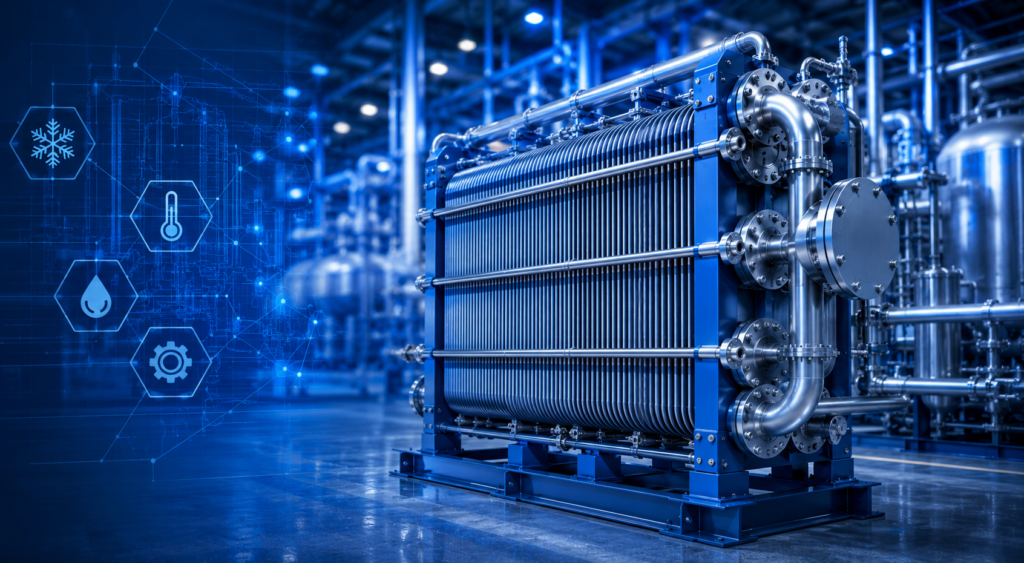
Cryogenic heat exchangers are among the most critical components in a nitrogen generation plant, making the Maintenance of Cryogenic Heat Exchangers essential for reliable and efficient operation. Their performance directly influences production capacity, nitrogen purity, power consumption, and overall plant reliability.
Unlike conventional heat exchangers, cryogenic heat exchangers operate at extremely low temperatures where even minor contamination, moisture ingress, or process imbalances can significantly reduce thermal efficiency and process stability.
Many operational issues—including purity fluctuations, production losses, pressure instability, and increased energy consumption—can often be traced to deteriorating heat exchanger performance. As a result, maintaining optimal exchanger condition is a key responsibility for plant operators and maintenance teams.
Understanding and implementing effective maintenance practices helps prevent failures, improve long-term reliability, minimize downtime, and maximize the overall efficiency of cryogenic nitrogen plants.
Why Maintenance of Cryogenic Heat Exchangers Is Critical
The Maintenance of Cryogenic Heat Exchangers begins with understanding their vital role in nitrogen plant operation. The main heat exchanger serves as the heart of the cold box, enabling efficient refrigeration recovery and supporting the cryogenic separation process.
Its primary functions include:
Cooling incoming compressed air to cryogenic temperatures
Recovering refrigeration from outgoing product and waste streams
Supporting efficient separation within the distillation columns
Maintaining thermal balance throughout the cold box
Because the heat exchanger is closely integrated with every major process system, even a small reduction in thermal performance can affect overall plant efficiency and stability.
Common consequences of deteriorating heat exchanger performance include:
Reduced nitrogen production capacity
Lower product purity
Increased distillation column instability
Higher compressor power consumption
Longer startup and cooldown periods
For this reason, effective maintenance and continuous performance monitoring are essential for maintaining reliable plant operation and achieving long-term process efficiency.
Quick Engineering Summary
The Maintenance of Cryogenic Heat Exchangers is essential for ensuring reliable and efficient operation of nitrogen generation plants. As the primary equipment responsible for refrigeration recovery and process cooling, cryogenic heat exchangers directly influence nitrogen purity, production capacity, energy consumption, and overall plant stability.
Unlike conventional heat exchangers, cryogenic units operate under extremely low-temperature conditions and are highly sensitive to moisture contamination, hydrocarbon carryover, and process imbalances. Even minor performance degradation can result in increased pressure drop, reduced heat transfer efficiency, refrigeration losses, and operational instability throughout the plant.
Effective maintenance focuses not only on equipment condition but also on contamination prevention, air pretreatment reliability, performance monitoring, and early detection of abnormal operating trends. Long-term exchanger reliability depends on disciplined operation, continuous trend analysis, and proactive troubleshooting practices that prevent small issues from developing into major operational problems.
Common Causes of Heat Exchanger Performance Degradation
1. Moisture Contamination
Moisture entering the cold section can freeze and accumulate inside exchanger passages.
Potential sources include:
- Molecular sieve breakthrough
- Improper adsorber switching
- Moisture ingress during maintenance
- Damaged insulation systems
Common symptoms:
- Increasing pressure drop
- Cold-end temperature deviations
- Reduced production capacity
Effective Maintenance of Cryogenic Heat Exchangers requires strict moisture control throughout the air pretreatment and cold box systems. Even small amounts of moisture entering the cryogenic section can gradually reduce exchanger performance and increase operational risk.
2. Hydrocarbon Contamination
Oil carryover from air compressors may gradually deposit within heat exchanger passages.
Possible sources:
- Compressor oil leakage
- Ineffective oil removal systems
- Separator malfunction
Consequences include:
- Reduced heat transfer efficiency
- Increased pressure drop
- Safety concerns in oxygen-rich sections
A critical aspect of Maintenance of Cryogenic Heat Exchangers is preventing hydrocarbon contamination from reaching the cold section. Proper compressor oil management and filtration help preserve heat transfer efficiency and reduce long-term reliability issues.
3. Process Imbalance
Heat exchangers can experience performance deterioration due to operational factors such as:
- Incorrect process flow rates
- Design load deviations
- Expander instability
- Improper startup or shutdown practices
These issues may not physically damage the exchanger but can reduce overall effectiveness.
Key Parameters to Monitor
Effective Maintenance of Cryogenic Heat Exchangers begins with continuous monitoring of operating parameters and performance trends.
1. Temperature Approach
Unexpected changes in temperature difference across the exchanger may indicate:
- Fouling
- Moisture accumulation
- Flow imbalance
2. Pressure Drop
A gradual increase often indicates:
- Ice formation
- Passage restriction
- Internal contamination
3. Nitrogen Purity
Heat exchanger issues may indirectly affect separation efficiency and product purity.
4. Production Rate
Reduced production at unchanged operating conditions may signal declining exchanger performance.
5. Specific Power Consumption
Heat exchanger issues may indirectly affect separation efficiency and product purity.
Preventive Maintenance Practices
Successful Maintenance of Cryogenic Heat Exchangers relies on contamination prevention rather than corrective intervention.
1. Maintain Molecular Sieve Performance
The best heat exchanger maintenance strategy is preventing contamination from entering the cold box.
Key actions include:
- Regular adsorber inspection
- Monitoring regeneration effectiveness
- Verifying switching valve performance
- Tracking dew point trends
2. Monitor Compressor Oil Carryover
Operators should ensure:
- Oil separators function correctly
- Coalescing filters are maintained
- Compressor oil levels remain within limits
- Oil analysis programs are implemented
3. Control Startup and Shutdown Procedures
Rapid temperature changes can introduce thermal stresses.
Good practices include:
- Following approved cooldown procedures
- Avoiding sudden process changes
- Maintaining stable operating conditions
- Following recommended warm-up procedures before maintenance
4. Maintain Insulation Integrity
Damaged insulation can result in:
- External moisture ingress
- Ice formation
- Increased heat leak
Routine inspection of cold box insulation should be part of every maintenance program.
Warning Signs That Require Investigation
Operators should immediately investigate:
- Rising heat exchanger pressure drop
- Increasing compressor power consumption
- Reduced nitrogen production
- Unexpected purity fluctuations
- Cold box temperature profile deviations
- Repeated process instability
Ignoring early warning signs often allows problems to worsen and increases maintenance costs.
One of the most important objectives of Maintenance of Cryogenic Heat Exchangers is identifying abnormal operating trends before they affect production or purity.
Troubleshooting Approach
Effective Maintenance of Cryogenic Heat Exchangers requires a structured troubleshooting process focused on root-cause identification.
Step 1: Review Historical Trends
Compare: 1 ) Pressure drop 2) Temperature profiles 3) Product purity 4) Production rates against previous stable operating periods.
Step 2: Check Air Pretreatment Systems
Verify: 1) Molecular sieve operation 2) Regeneration temperatures 3) Dew point measurements 4) Valve sequencing
Step 3: Evaluate Process Conditions
Review: 1) Air flow rates 2) Expander operation 3) Column pressures 4) Product demand variations
Step 4: Identify Root Causes
Avoid focusing solely on symptoms. A pressure increase, purity drop, or production loss may originate elsewhere in the process and only appear at the heat exchanger.
Practical Engineering Insight
One of the most important lessons in the Maintenance of Cryogenic Heat Exchangers is recognizing that the heat exchanger is often not the source of the problem but the first component to reveal underlying process deficiencies.
Operators frequently associate heat exchanger issues with visible symptoms such as rising pressure drop, reduced nitrogen production, or declining thermal performance. However, these symptoms are often the result of upstream problems including molecular sieve breakthrough, compressor oil carryover, inadequate regeneration, unstable expander operation, or improper startup and shutdown practices.
Effective troubleshooting should therefore extend beyond the heat exchanger itself and evaluate the entire process chain. Plants that consistently achieve reliable performance treat heat exchanger operating trends as an early-warning diagnostic tool rather than simply a maintenance concern. Small changes in temperature approach, pressure drop, product purity, or specific power consumption often provide valuable indications of developing process issues long before major operational disturbances occur.
From an engineering perspective, the most successful maintenance programs focus on identifying root causes early, preventing contamination from entering the cold section, and using performance trends to guide proactive operational decisions.
Best Practices for Long-Term Reliability
Plants that achieve stable long-term performance typically: * Monitor exchanger trends continuously * Maintain strict moisture control * Minimize compressor oil carryover * Follow disciplined startup procedures * Investigate abnormal trends early * Maintain accurate operational records.
These practices help maximize exchanger life while reducing downtime and troubleshooting costs.
Long-term Maintenance of Cryogenic Heat Exchangers should combine trend monitoring, contamination control, and disciplined operating practices.
Engineering Perspective
From an engineering perspective, the Maintenance of Cryogenic Heat Exchangers is most effective when it focuses on process control and contamination prevention rather than reactive equipment intervention. The most reliable heat exchangers are not necessarily those receiving the most maintenance attention, but those operating within a stable and well-managed process environment.
The primary objective should be preventing contaminants from entering the cold section rather than attempting to remove their effects after performance has deteriorated. Once moisture, hydrocarbons, or operational disturbances impact the heat exchanger, corrective actions often become significantly more complex, time-consuming, and costly. As a result, investments in molecular sieve reliability, compressor oil management, trend monitoring, and disciplined operating practices typically provide greater long-term value than reactive maintenance activities.
As modern nitrogen plants continue to pursue higher efficiency, reliability, and operational excellence, cryogenic heat exchangers should be viewed as more than just heat transfer equipment. They serve as a valuable indicator of overall plant health, providing engineers with critical insights into process stability, contamination control, equipment condition, and operational discipline. In many cases, changes in heat exchanger performance offer the earliest warning of developing process issues, making continuous monitoring an essential part of a successful maintenance strategy.

Engineering Basis
- International Society of Automation – Control loop behavior, analyzer interaction, and process stability
- Process Control Engineering – System dynamics and feedback interactions
- National Institute of Standards and Technology – Gas property behavior under varying temperature and pressure
Conclusion & Key Takeaways
The Maintenance of Cryogenic Heat Exchangers plays a vital role in ensuring the efficiency, reliability, and long-term performance of nitrogen generation plants. As the primary equipment responsible for refrigeration recovery and process cooling, cryogenic heat exchangers directly influence nitrogen purity, production capacity, energy consumption, and overall plant stability.
Although cryogenic heat exchangers generally require limited direct maintenance, their performance depends heavily on effective air pretreatment, contamination control, and stable operating conditions. Moisture ingress, hydrocarbon carryover, and process imbalances can gradually reduce thermal efficiency, resulting in increased pressure drop, production losses, purity fluctuations, and higher operating costs.
Successful maintenance extends beyond the heat exchanger itself and requires a plant-wide approach focused on contamination prevention, continuous performance monitoring, disciplined operating practices, and proactive root-cause analysis. By identifying abnormalities early and maintaining a stable process environment, plant operators can maximize heat exchanger reliability, reduce unplanned downtime, and sustain optimal nitrogen plant performance over the long term.
Key Takeaways
The long-term success of Maintenance of Cryogenic Heat Exchangers depends on combining contamination prevention, performance monitoring, disciplined operating practices, and timely troubleshooting. Plants that adopt this proactive approach typically experience fewer operational disruptions and improved overall efficiency.
✅ Cryogenic heat exchangers are critical for refrigeration recovery, process cooling, and nitrogen separation efficiency.
✅ Moisture contamination is one of the most common causes of performance degradation and can lead to ice formation, pressure drop increases, and production losses.
✅ Compressor oil carryover can reduce heat transfer efficiency and create operational as well as safety concerns.
✅ Key performance indicators include temperature approach, pressure drop, nitrogen purity, production rate, and specific power consumption.
✅ Molecular sieve reliability is the first line of defense against heat exchanger contamination.
✅ Small changes in temperature profile or pressure drop often provide early warning signs of developing problems.
✅ Effective troubleshooting should investigate upstream causes rather than focusing only on exchanger symptoms.
✅ Stable startup and shutdown procedures help minimize thermal stress and maintain long-term exchanger integrity.
✅ Continuous trend monitoring and early intervention significantly reduce downtime and maintenance costs.
✅ The most successful plants treat heat exchanger performance as a key indicator of overall process health rather than simply another piece of equipment.
Protect Your Heat Exchanger Before Performance Declines
Most cryogenic heat exchanger problems do not begin inside the exchanger itself. Moisture breakthrough, compressor oil carryover, poor regeneration practices, and process instability often create performance losses long before operators notice reduced production or purity fluctuations.
Need Help Diagnosing Heat Exchanger Performance Issues?
Experiencing rising pressure drop, purity fluctuations, reduced nitrogen production, or cold box instability? Many heat exchanger-related problems originate from moisture contamination, refrigeration imbalance, or operational issues that require a systematic engineering assessment.
Our cryogenic nitrogen plant consulting services help operators identify root causes, improve reliability, and restore stable plant performance.
Discuss Your Plant Performance Challenges